ISO 9001:2015
 ZED Bronze Certified

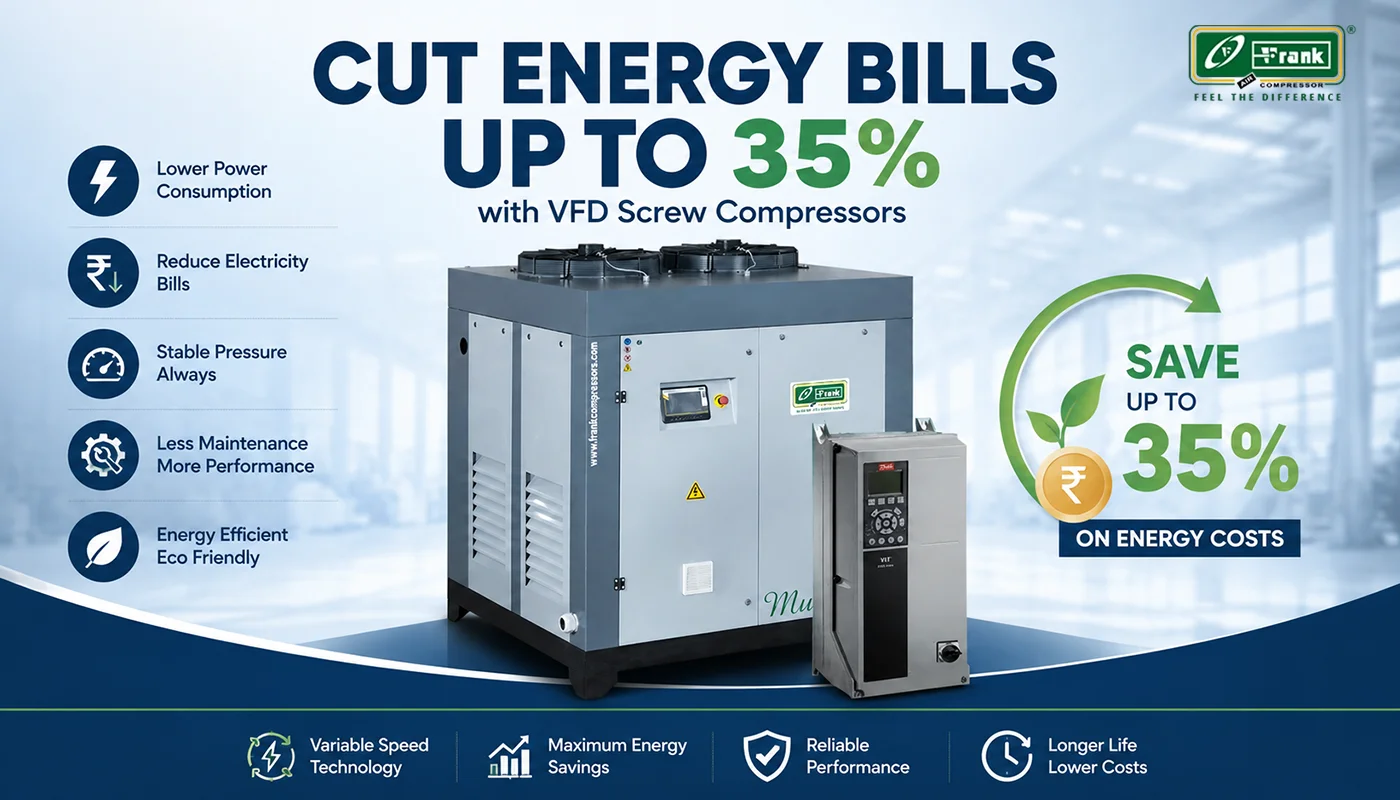
VFD Compressors: Reduce Factory Energy Costs Up to 35%
Compressed air is often called the "fourth utility," but it’s the only one that routinely drains 20% to 40% of your factory’s entire electricity budget. The real tragedy? A massive portion of that expenditure isn't powering your tool, it’s fueling inefficiency. If your facility relies on fixed-speed compressors, you aren't just paying for production; you are unknowingly funding a persistent, silent waste of energy that hits your bottom line every single month.
The Fixed-Speed Problem Nobody Talks About
Here's what actually happens with a traditional compressor. The motor runs at full speed constantly. When your line doesn't need that much air, the machine doesn't slow down. It shifts into "unloaded" mode, intake valve closed, motor still spinning, and burns 30 to 50% of full-load power while producing zero air.
Zero air. Full electricity bill.
That's not a minor inefficiency. Over a month, over a year, it adds up to a serious leak in your operating budget.
Is Your Compressor Costing You? 5 Warning Signs
If your fixed-speed compressor is outdated, it’s likely draining your budget. Here are some common warning signs:
- Unexplained Energy Spikes: Your power bills are climbing even when production remains steady.
- Erratic Cycling:The machine frequently turns on and off during low-demand periods, wasting power on "inrush" current.
- Unstable Pressure: Fluctuations in your line pressure are causing performance issues with downstream tools.
- Excessive Maintenance:You're constantly replacing valves, bearings, or contactors due to premature wear from load/unload cycles.
- Constant Noise:The unit sounds like it’s running at full capacity even when you aren't using much air.
If you’re seeing these, you’re paying for energy you aren't using. A VFD upgrade could be the smartest move for your bottom line.
What Does a VFD Screw Compressor Actually Do?
A Variable Frequency Drive controls motor speed by adjusting the electrical frequency going into it. With more demand, the motor speeds up. Less demand, it slows down. The compressor produces exactly the air the plant needs at any given moment.
The analogy that works: a fixed-speed compressor is like driving with your foot flat on the gas and using the brake to control speed. A VFD compressor uses the accelerator. You only burn what you actually need.
Key components that make VFD technology work:
- Frequency inverter that reads real-time system pressure
- Variable speed motor that adjusts RPM continuously
- Pressure sensors that feed live data back to the drive controller
- Smart control panel that manages load curves across shifts
- Integrated monitoring that flags inefficiencies before they become failures
How VFD Compressors Deliver Up to 35% Energy Savings
This isn't a marketing number. It comes from measurable changes in how electricity gets consumed across three specific areas.
1. No unload waste
Because the motor slows down instead of idling at full spin, the energy burned during traditional unloaded periods disappears from your bill entirely. For plants with shifting demand across a day, this one change alone moves the needle significantly.
2. Soft motor starts
Every time a fixed-speed motor kicks on, it pulls five to seven times its normal running current. That inrush hits your demand charges hard. VFDs ramp the motor up gradually, eliminating those spikes and reducing what your utility provider bills you at peak demand.
3. Tighter pressure bands
Fixed-speed units work within a wide pressure swing, sometimes 5 to 10 psi, to avoid constant cycling. A VFD holds pressure within 1 to 2 psi. Since higher pressure costs more energy, running consistently at the lowest acceptable pressure makes a compounding difference over time.
Beyond Energy: What Else Changes When You Switch
Energy saving is the headline. But there's more happening underneath it.
Operational benefits most plants notice within the first year:
- Component wear drops significantly because the motor isn't hammering between full load and stop repeatedly
- Maintenance intervals stretch by 20 to 30% in most facilities
- Replacement parts get purchased less often, reducing planned maintenance spend
- Noise levels fall noticeably since the compressor runs at demand-matched speeds rather than full throttle all day
- Pressure stability improves, which reduces rejects and rework on air-sensitive production lines
Environmental and compliance benefits:
- Lower electricity consumption means a directly reduced carbon footprint
- For facilities tracking ESG metrics, a VFD upgrade produces a clear, verifiable emissions number
- Some regions offer utility rebates or government incentives for energy-efficient compressor upgrades, shortening payback further
Who Benefits Most From a VFD Upgrade?
Not every facility sees the same return. The technology works best in specific operating conditions.
Your plant is suitable if:
- Production runs variable shifts with changing air demand throughout the day
- You operate multiple product lines with different compressed air requirements
- Your facility has seasonal demand swings that affect compressor load significantly
- Current compressor cycles frequently between loaded and unloaded states
- Energy costs represent a meaningful share of your total cost of production
The upgrade makes less sense if:
- Your compressed air demand runs at near-constant full capacity for most of the operating day
- The existing compressor is relatively new and under active maintenance contract
- Facility is scheduled for major production changes within the next 12 to 18 months
When a Compressed Air Audit Makes a VFD Upgrade Pay Off
The starting point is a compressed air audit. Most reputable suppliers will run one at no charge. It measures actual air usage across a full week and shows exactly where a fixed-speed unit is spinning for nothing.
What a good audit should tell you:
- Average system pressure versus actual minimum required pressure
- Time spent in loaded versus unloaded states across each shift
- Estimated annual energy cost under current fixed-speed operation
- Projected savings under VFD operation at your specific demand profile
- Realistic payback period based on current electricity tariffs
If those gaps are large, payback on a VFD unit typically comes in 18 to 24 months on energy savings alone. After that, every month the margin recovered.
Save Energy Bills With Frank VFD Screw Air Compressors
Energy costs are not going down. The factories that move on efficiency now protect their margins later. Switching from fixed-speed to VFD screw compressors is not just a mechanical upgrade. It is reclaiming up to 35 % of your power expenditure and putting it back where it belongs, into the business.
The air you're wasting right now has a price. A VFD stops paying it.
Ready to Stop Overpaying for Compressed Air? Talk to Frank Compressors.
Frank Compressors has been helping Indian manufacturing facilities cut energy costs through precision-engineered VFD screw compressor solutions. Whether you're running a single-shift plant or a round-the-clock production facility, their team understands what variable demand looks like on the factory floor and how to match the right compressor to your actual operating profile.
Here's what you get when you work with Frank Compressors:
- Free compressed air audit that maps your real usage patterns across shifts
- Site-specific VFD compressor recommendations backed by energy calculations
- Transparent ROI projections based on your current electricity tariffs
- Installation support and commissioning by trained field engineers
- After-sales service and maintenance programs that protect your investment long term
The savings are real. The payback is measurable. And the first conversation costs nothing.
Contact Frank Compressors today and find out exactly how much your current system is costing you.

Recent Blogs
- How to Select a Rotary Screw Air Compressor for Factories?
- Why Permanent Magnet Motor Screw Compressor Saves Energy?
- Air Compressors in EV Battery Manufacturing: What to Know?
- How Do VFD Screw Compressors Save 35% on Energy Bills?
- How to Identify and Fix Air Leaks in Compressed Air Systems?
- How to Remove Moisture from Compressed Air Effectively?
- Choosing the Right Air Compressor Capacity for Your Factory
- How Energy-Efficient Compressors Cut Industrial Power Costs
- Single vs Two-Stage Reciprocating Air Compressor Overview
- Top 10 Air Compressor Manufacturers in Coimbatore
- Air Compressors for Electronics & Semiconductor Industry
- Understanding Oil-Free Scroll Air Compressors & Advantages
- Oil-Free vs Oil-Injected Compressors for Textile Industry
- Tips to Pick The Best High-Pressure Compressor For Business
- Key Things to Check Before Installing a PET Air Compressor
- Benefits of Dual-Stage and Single-Stage Air Compressors
- How to Silence an Air Compressor for a Peaceful Workspace?
- Expert Tips to Select Screw Air Compressor For Packaging
- Benefits of Oil-Free Air Compressors For Food & Beverage Safety
- The Importance of Refrigeration Air Dryers in Pharma Production
- Why Choose a Permanent Magnetic Energy Saving Compressor
- The Importance of Air Compressors in Laser Cutting Machines
- How Dental Air Compressors Benefit the Medical Sector
- Key Applications and Benefits of Piston Vacuum Pumps in Industry
- Understanding The Role of Air Dryers in Compressed Air System
- Why Choose Rotary Screw Air Compressors: Essential Advantages
- Innovative Design Features of Screw Compressors with VFD
- Which One to Choose: Piston Vacuum Pumps vs Rotary Vane Vacuum Pumps?
- A Step By Step Guide For Air Compressor Installation & Setup
- Tips For Improve Your Compressor Life Span
- Different Types Of Compressors And Their Uses In Industries
- High-Pressure Air Compressors: Uses and Advantages for Industrial Solutions
- How Air Compressors Are Transforming The Textile Industry ?
- Tips For Prolonging Your Air Compressor's Lifespan