ISO 9001:2015
 ZED Bronze Certified

Role of Air Compressors in EV Battery Manufacturing in India
If you run an EV battery plant in India, a single moisture droplet or trace of oil in your compressed air line can ruin an entire cell production batch. That single fact is why air compressors in EV battery manufacturing have quietly become one of the most important utilities on the shop floor, not a back office afterthought.
The electric vehicle industry in India is moving at a rapid pace, with gigafactories, cell assembly units, and battery packs facilities being set up all over Gujarat, Tamil Nadu, Karnataka, and other states. Each one of these establishments requires clean and dry compressed air for production processes.
In this guide, we'll walk through where compressed air fits into EV battery production, which compressor types work best, who across the EV ecosystem actually depends on them, and how to choose the right system for your plant.
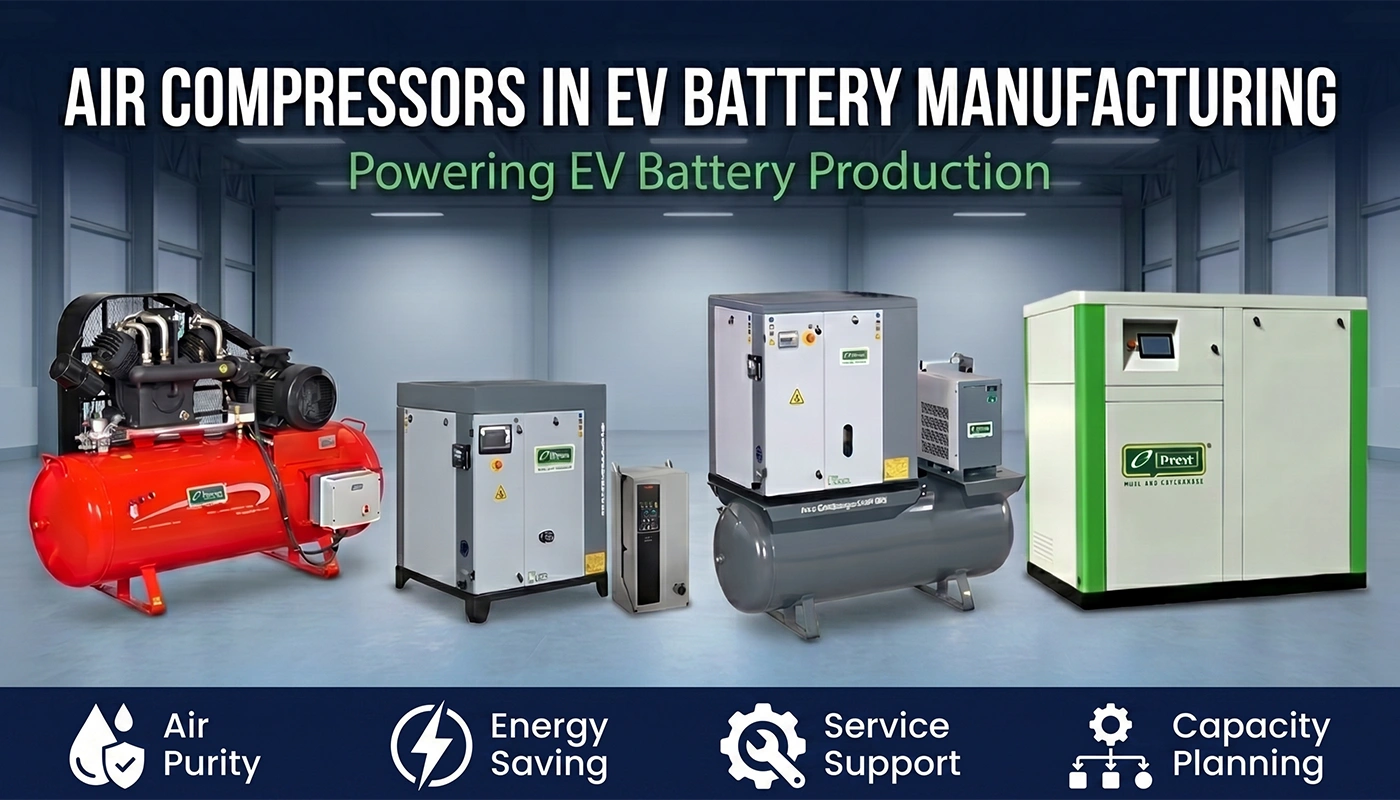
Why Air Compressors Matter in EV Battery Manufacturing?
Demand for vehicles powered by electricity is changing the utilization of compressed air within the industry. The electric vehicle compressor market witnessed revenue generation of around USD 2,552.6 million by the close of 2024 and is expected to witness growth with a CAGR of 16.7 percent from 2024 to 2030 according to data published by P&S Intelligence.
For Indian automotive companies, that is a chance for opportunity and responsibility. With battery gigafactories being set up in the nation on account of attractive government incentives, the demand for industrial grade air compressors in EV battery manufacturing is on a similar upward trend.
Contrary to regular automobiles, electric vehicle batteries have higher sensitivity towards impurities, moisture content, and pressure variation. The choice of an inappropriate air compressor might not only lead to wastage of resources but could also impact safety of cells and their performance.
Where Compressed Air is Used in Production
Compressed air is the "invisible force" behind several stages of battery manufacturing:
- Electrode Coating and Calendaring: Constant, clean pressure is required for coating machines to ensure uniform, defect-free layers on aluminum and copper foils.
- Cell Assembly and Welding: Pneumatic tools power the precision fixtures and holding devices used during laser welding and assembly, ensuring a perfect seal.
- Dry Room Support: While HVAC systems control the environment, compressed air is often used to power the actuators and valves that keep these ultra-low dew point environments functioning accurately.
- Leak Testing: Ensuring that finished cells and modules are hermetically sealed is vital; compressed air is used to perform high-precision pressure decay tests before the cells move to the final pack assembly line.
- Material Handling: Pneumatic transport systems are frequently employed to move sensitive active materials like lithium, cobalt, and graphite through the facility without risk of physical contamination.
Types of Air Compressors Used in EV Battery Manufacturing
Not every compressor is suitable for battery grade environments. The table below compares the most common types used across EV battery manufacturing plants.
Industrial Compressor Comparison
| Compressor Type | Best Suited For | Air Purity (ISO 8573-1) | Energy Efficiency |
|---|---|---|---|
| Oil-free Screw | Dry rooms, pharma, food processing | Class 0 | High (especially VSD models) |
| Oil-free Scroll | Labs, dental, medical, sensitive environments | Class 0 | Moderate to High |
| Rotary Screw | Continuous heavy-duty industrial operations | Class 1 to 2 | Moderate to High (PM/VSD options) |
| Reciprocating (Piston) | Small workshops, intermittent use, high-pressure needs | Class 2 to 3 (varies) | Moderate |
| Diesel Engine Driven | Remote construction sites, outdoor industrial use | Varies | Moderate |
| PET Compressors | High-speed bottle production/bottling industries | Varies | High (Specialized) |
For most EV battery manufacturing applications, oil free compressors are non-negotiable, since even trace oil vapor can contaminate sensitive electrode and cell materials.
Who Needs Air Compressors in EV Manufacturing?
Compressed air isn't just a cell manufacturing concern. Across India's EV value chain, five distinct groups depend on it daily — each with very different demands.
- Battery Cell Manufacturers:The most quality sensitive. Their dry rooms, electrode coating lines, and leak testing stations all need oil free screw compressors with VSD control to maintain Class 0 air purity and tight humidity levels.
- Battery Pack Assemblers:Rely on compressed air for pneumatic tools and module assembly. Precision and uptime matter most here, making oil free piston or scroll compressors the preferred choice.
- EV Vehicle OEMs:Use compressed air across painting booths, assembly tooling, and tyre inflation. They need versatile systems that handle multiple applications simultaneously, typically a lubricated or oil free screw setup.
- EV Charging Infrastructure Makers:Work at a smaller scale but still depend on clean air for enclosure assembly and testing rigs. A compact oil free piston compressor usually fits the bill.
- Tier 1 Component Suppliers:Handle stamping, welding, and finishing — processes where cost efficiency drives compressor selection more than air purity alone.
This wide range of needs is exactly why generic, one size fits all compressors often underperform in demanding EV battery manufacturing settings.
Smart Ways to Choose Air Compressors for EV Battery Plants
Before investing in a new compressed air system, manufacturers should evaluate a few critical factors.
-
Air Purity Compliance
Ensure ISO 8573-1 Class 0 oil-free air certification for all processes involving cells, electrodes, and dry rooms to eliminate contamination risks. -
Capacity Planning
Design the system for current demand and future expansion since EV battery plants scale quickly and air demand can increase over time. -
Energy Efficiency
Use variable speed drive systems and heat recovery options to reduce power consumption and improve long term operational efficiency. -
Air Treatment
Install dryers, filtration systems, and dew point control to maintain stable air quality and prevent moisture related defects. -
Service & Maintenance Support
Select a supplier with strong local service and maintenance support to minimize downtime and ensure uninterrupted production.
Power Up Your EV Battery Plant With Frank Air Compressors
The Indian electric vehicle (EV) battery manufacturing industry is growing rapidly, and the compressor that resides in your utility room may either evolve alongside this trend or hinder it silently. Whether it involves controlling the moisture content in a dry room or carrying out leak testing and pneumatic assembly, the role of air compressors in EV battery manufacturing cannot be overstated when it comes to maintaining consistency and reliability.
Frank Compressors stands as a trusted air compressor manufacturer for EV battery plants in India We deliver solutions designed to meet demanding industrial requirements with a focus on efficiency, reliability, and performance. With a strong understanding of EV manufacturing needs, Frank Compressors supports factories in building stable and future ready production systems. Contact Frank Compressors today for advanced air solutions that power your manufacturing excellence.

Recent Blogs
- How to Select a Rotary Screw Air Compressor for Factories?
- Why Permanent Magnet Motor Screw Compressor Saves Energy?
- Air Compressors in EV Battery Manufacturing: What to Know?
- How Do VFD Screw Compressors Save 35% on Energy Bills?
- How to Identify and Fix Air Leaks in Compressed Air Systems?
- How to Remove Moisture from Compressed Air Effectively?
- Choosing the Right Air Compressor Capacity for Your Factory
- How Energy-Efficient Compressors Cut Industrial Power Costs
- Single vs Two-Stage Reciprocating Air Compressor Overview
- Top 10 Air Compressor Manufacturers in Coimbatore
- Air Compressors for Electronics & Semiconductor Industry
- Understanding Oil-Free Scroll Air Compressors & Advantages
- Oil-Free vs Oil-Injected Compressors for Textile Industry
- Tips to Pick The Best High-Pressure Compressor For Business
- Key Things to Check Before Installing a PET Air Compressor
- Benefits of Dual-Stage and Single-Stage Air Compressors
- How to Silence an Air Compressor for a Peaceful Workspace?
- Expert Tips to Select Screw Air Compressor For Packaging
- Benefits of Oil-Free Air Compressors For Food & Beverage Safety
- The Importance of Refrigeration Air Dryers in Pharma Production
- Why Choose a Permanent Magnetic Energy Saving Compressor
- The Importance of Air Compressors in Laser Cutting Machines
- How Dental Air Compressors Benefit the Medical Sector
- Key Applications and Benefits of Piston Vacuum Pumps in Industry
- Understanding The Role of Air Dryers in Compressed Air System
- Why Choose Rotary Screw Air Compressors: Essential Advantages
- Innovative Design Features of Screw Compressors with VFD
- Which One to Choose: Piston Vacuum Pumps vs Rotary Vane Vacuum Pumps?
- A Step By Step Guide For Air Compressor Installation & Setup
- Tips For Improve Your Compressor Life Span
- Different Types Of Compressors And Their Uses In Industries
- High-Pressure Air Compressors: Uses and Advantages for Industrial Solutions
- How Air Compressors Are Transforming The Textile Industry ?
- Tips For Prolonging Your Air Compressor's Lifespan