ISO 9001:2015
 ZED Bronze Certified

What is a PM Motor Screw Compressor and Why Is It Efficient?
Compressed air is an essential part of many manufacturing processes, but running a compressor can account for a significant share of a plant's energy consumption. This makes compressor efficiency an important consideration for industries looking to reduce operating costs without compromising compressed-air supply.
A permanent magnet motor screw compressor is a rotary screw compressor powered by a permanent magnet motor, typically combined with VFD control and direct drive. Unlike a conventional induction motor, the permanent magnet motor uses magnets to generate the rotor's magnetic field, which helps reduce rotor losses. When combined with variable-speed operation, the compressor can adjust its output according to changing compressed-air demand, helping reduce unnecessary energy consumption.
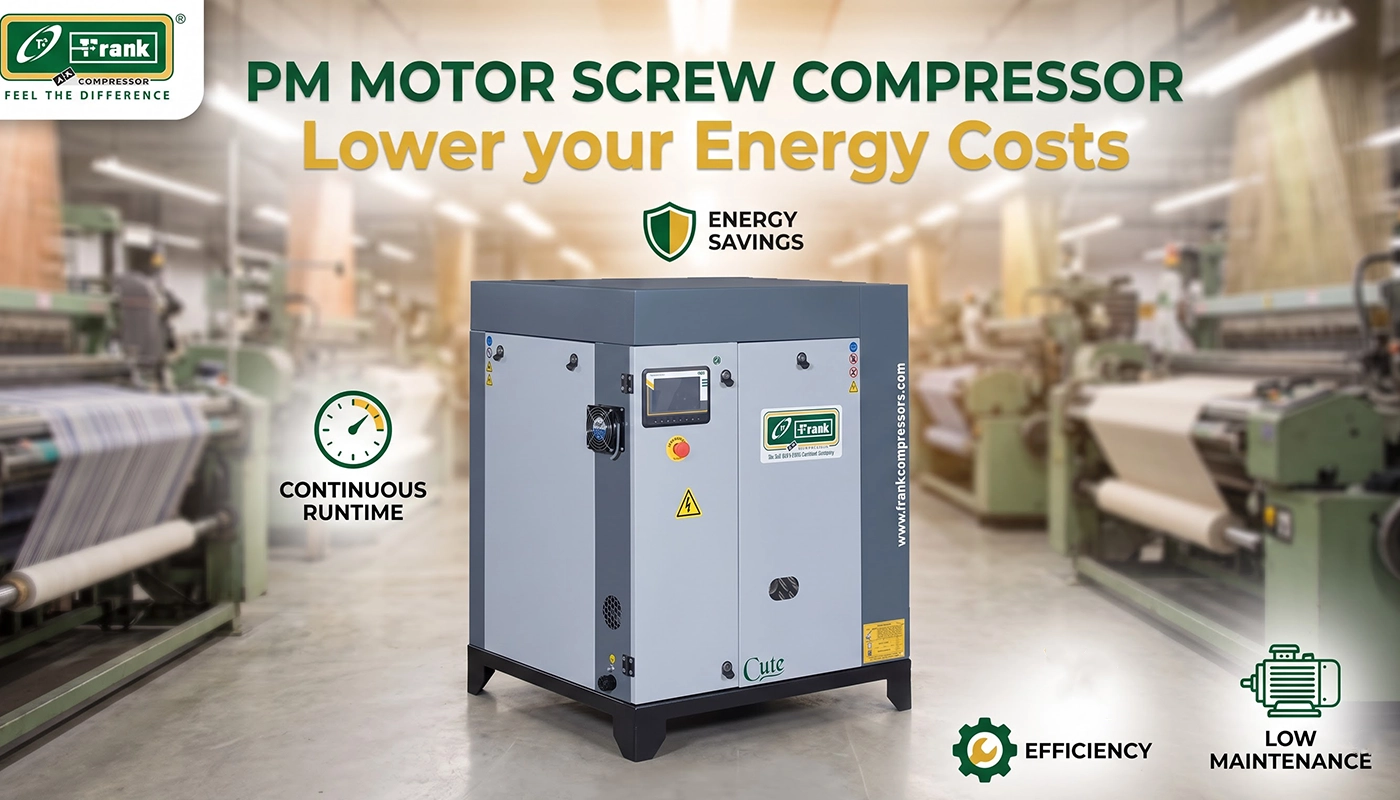
Here is a simpler explanation of the cost savings example. The provided example compares the energy cost of two types of air compressors running for one year (8000 hours) at a cost of ₹8 per KW.
| Product | Annual Energy Cost | Your Savings |
|---|---|---|
| Standard Compressor (37.5 KW) | ₹ 24,00,000 | - |
| Frank PM Compressor (37.5 KW) | ₹ 14,40,000 | ₹ 9,60,000 |
By choosing the Frank PM Compressor, you save 40% on your energy bills, resulting in an annual savings of ₹9,60,000.
What Makes a PM Motor Screw Compressor Different
The basic screw compression principle remains the same, but the motor and drive arrangement changes how electrical power is converted into mechanical power. A permanent magnet motor uses magnets in the rotor to generate its magnetic field, avoiding the excitation losses associated with a conventional induction motor.
| Factor | Conventional Induction Motor | Permanent Magnet Motor |
|---|---|---|
| Rotor magnetic field | Generated through induction | Generated by permanent magnets |
| Rotor excitation | Requires induced current | Does not require conventional rotor excitation |
| Rotor losses | Higher | Lower |
| Part-load efficiency | Can reduce as load falls | Generally maintains stronger efficiency |
| Power density | Typically lower | Higher, allowing a more compact motor |
For a screw compressor, the lower motor losses can reduce the electrical power required for a given output. The higher power density of permanent magnet motors can also support a more compact compressor design. These characteristics become particularly relevant when the compressor operates across different load levels rather than at a constant full load.
How PM Technology Reduces Compressor Energy Use
The energy advantage does not come from the permanent magnet motor alone. In practical compressor operation, motor efficiency, variable-speed control and power transmission work together to reduce avoidable energy use.
- Lower motor losses: Permanent magnets provide the rotor's magnetic field without the excitation losses found in conventional induction motors. This reduces heat generation and improves electrical-to-mechanical efficiency.
- Variable-speed operation: A VFD adjusts motor speed according to compressed-air demand. When demand falls, the compressor can reduce output instead of continuing to operate at a fixed speed.
- Reduced unloaded operation: Matching production to demand limits the energy used when the plant requires less air.
- Direct drive: In a direct-drive configuration, the motor is coupled directly to the compressor element, reducing losses and maintenance associated with belts or other transmission components.
- Pressure control: Variable-speed control allows the compressor to respond more closely to system pressure requirements, helping avoid unnecessary compression.
These factors are particularly relevant in plants where compressed-air demand varies during production. Rather than relying on a single efficiency characteristic, the PM screw compressor improves energy performance through the combined operation of its motor and control system.
PM Screw Compressors for Different Manufacturing Applications
The practical value of a PM screw compressor depends on the plant's operating profile. The technology is particularly relevant where compressed air is required for long production periods and demand varies between processes or shifts.
Typical operating environments include:
- Textile manufacturing: Pneumatic equipment can operate for extended periods, making compressor energy consumption an ongoing operating consideration.
- Automotive production: Assembly tools, automation and pneumatic systems can create changing air requirements across production lines.
- Continuous-process manufacturing: Long compressor runtimes increase the importance of reducing motor and transmission losses.
- Variable-load plants: Where air consumption changes throughout production, VFD control can help align compressor output with actual demand.
For these applications, the potential efficiency benefit is best evaluated against the plant's air demand, pressure requirements, operating hours and load profile rather than by motor efficiency alone. This gives a more realistic basis for comparing a PM screw compressor with an existing system.
How Frank Compressors Applies PM Technology
The efficiency potential of permanent magnet technology also depends on how the motor, compressor element and control system are integrated. Frank Compressors' PM screw compressor range combines these elements for industrial operating requirements.
Key elements of the configuration include:
- IE4-grade permanent magnet motor: Supports high motor efficiency with reduced rotor losses.
- VFD control: Adjusts compressor speed in response to changing air demand.
- Direct-drive arrangement: Transfers motor power directly to the compression element while eliminating belt-related transmission losses.
- Compact motor design: Higher power density helps maintain a compact equipment footprint.
- Monitoring capability: Provides operating information that can help track compressor performance and energy consumption.
- Industrial-grade components: Frank's PM screw compressor models incorporate German components as part of their design.
The Cutie and Jumbo series apply this configuration to different industrial compressed-air requirements, combining PM motor technology with screw compression and variable-speed operation.
Evaluating PM Compressor Performance
The efficiency advantage of a permanent magnet screw compressor should be considered over the compressor's actual operating cycle rather than from motor efficiency alone. A plant running for long hours with varying air demand can make greater use of the PM motor and VFD's ability to operate efficiently across different load conditions.
When comparing compressor options, specific power consumption, required air flow, operating pressure, duty cycle and demand variation provide a more useful basis than a headline energy-saving percentage. Actual savings will depend on the existing compressor, system conditions and how the equipment is operated.
For manufacturing plants where compressed air represents a substantial and continuous energy requirement, these factors make PM technology a relevant option when evaluating the next generation of screw compressor systems.
Save Energy with Frank PM Motor Screw Compressor
Permanent magnet motor screw compressors can improve compressor efficiency through lower motor losses, variable-speed operation and direct power transmission. These benefits are particularly relevant for manufacturing plants with long operating hours or fluctuating compressed-air demand, where compressor performance needs to be evaluated across the complete operating cycle. Frank Compressors combines permanent magnet motor, VFD and direct-drive technologies in its permanent magnet motor screw compressor solutions, designed for industrial applications where energy efficiency, reliable operation and consistent compressed-air supply are important considerations.
If your plant is evaluating a more energy-efficient screw compressor, Frank Compressors can help you identify a PM compressor configuration based on your required airflow, pressure, operating hours and demand profile. Explore Frank Compressors' permanent magnet motor screw compressors and choose a solution designed for your manufacturing requirements.

Recent Blogs
- How to Select a Rotary Screw Air Compressor for Factories?
- Why Permanent Magnet Motor Screw Compressor Saves Energy?
- Air Compressors in EV Battery Manufacturing: What to Know?
- How Do VFD Screw Compressors Save 35% on Energy Bills?
- How to Identify and Fix Air Leaks in Compressed Air Systems?
- How to Remove Moisture from Compressed Air Effectively?
- Choosing the Right Air Compressor Capacity for Your Factory
- How Energy-Efficient Compressors Cut Industrial Power Costs
- Single vs Two-Stage Reciprocating Air Compressor Overview
- Top 10 Air Compressor Manufacturers in Coimbatore
- Air Compressors for Electronics & Semiconductor Industry
- Understanding Oil-Free Scroll Air Compressors & Advantages
- Oil-Free vs Oil-Injected Compressors for Textile Industry
- Tips to Pick The Best High-Pressure Compressor For Business
- Key Things to Check Before Installing a PET Air Compressor
- Benefits of Dual-Stage and Single-Stage Air Compressors
- How to Silence an Air Compressor for a Peaceful Workspace?
- Expert Tips to Select Screw Air Compressor For Packaging
- Benefits of Oil-Free Air Compressors For Food & Beverage Safety
- The Importance of Refrigeration Air Dryers in Pharma Production
- Why Choose a Permanent Magnetic Energy Saving Compressor
- The Importance of Air Compressors in Laser Cutting Machines
- How Dental Air Compressors Benefit the Medical Sector
- Key Applications and Benefits of Piston Vacuum Pumps in Industry
- Understanding The Role of Air Dryers in Compressed Air System
- Why Choose Rotary Screw Air Compressors: Essential Advantages
- Innovative Design Features of Screw Compressors with VFD
- Which One to Choose: Piston Vacuum Pumps vs Rotary Vane Vacuum Pumps?
- A Step By Step Guide For Air Compressor Installation & Setup
- Tips For Improve Your Compressor Life Span
- Different Types Of Compressors And Their Uses In Industries
- High-Pressure Air Compressors: Uses and Advantages for Industrial Solutions
- How Air Compressors Are Transforming The Textile Industry ?
- Tips For Prolonging Your Air Compressor's Lifespan