ISO 9001:2015
 ZED Bronze Certified

How to Choose the Right Rotary Screw Air Compressor
Choosing a rotary screw air compressor for a factory requires more than selecting a model based on horsepower. The compressor needs to match the plant's airflow, pressure, operating hours, air-quality requirements and demand pattern. The right selection can maintain stable production while controlling energy and maintenance costs.
Why Air Compressors Matter in EV Battery Manufacturing?
Demand for vehicles powered by electricity is changing the utilization of compressed air within the industry. The electric vehicle compressor market witnessed revenue generation of around USD 2,552.6 million by the close of 2024 and is expected to witness growth with a CAGR of 16.7 percent from 2024 to 2030 according to data published by P&S Intelligence.
For Indian automotive companies, that is a chance for opportunity and responsibility. With battery gigafactories being set up in the nation on account of attractive government incentives, the demand for industrial grade air compressors in EV battery manufacturing is on a similar upward trend.
Contrary to regular automobiles, electric vehicle batteries have higher sensitivity towards impurities, moisture content, and pressure variation. The choice of an inappropriate air compressor might not only lead to wastage of resources but could also impact safety of cells and their performance.
Rotary Screw Compressor CFM and Pressure Requirements
Airflow and pressure are the starting points for compressor selection. Calculate the combined CFM requirement of pneumatic tools, machinery and production processes that may operate simultaneously. Then account for demand fluctuations, system leakage and planned production expansion.
Pressure must also be considered separately. The compressor should meet the highest pressure required by the application while allowing for pressure losses through piping, filters, dryers and other components.
| Selection Factor | What to Assess |
|---|---|
| Airflow | Total CFM or m³/min demand |
| Pressure | Required PSI or bar |
| Peak Demand | Maximum simultaneous consumption |
| Future Demand | Planned production expansion |
| System Losses | Leakage and pressure drop |
Oversizing is not automatically safer. An excessively large compressor can operate inefficiently at low demand, while an undersized unit may struggle to maintain production pressure.
Rotary Screw Compressor Duty Cycle for Factory Operations
Compressed air is used in factory applications for extended production times. Rotary screw compressors are commonly suited to continuous-duty applications and can supply air to assembly, machining, painting, packaging and fabrication processes.
For applications requiring extended or continuous operation, a compressor designed for continuous-duty service may be appropriate. By contrast, reciprocating compressors tend to be more suitable for intermittent use.
An air receiver can help manage short-term fluctuations in demand and reduce pressure fluctuations, but it does not replace the need to correctly size the compressor.
Oil-Injected vs Oil-Free Rotary Screw Compressors
The required compressed-air quality determines whether an oil-injected or oil-free compressor is appropriate.
Oil-injected rotary screw compressors use oil for sealing, cooling and lubrication. They are widely used in general manufacturing, engineering, automotive and fabrication applications where the required air-quality specification can be achieved through suitable filtration and air treatment.
Oil-free screw compressors eliminate oil from the compression process and are intended for applications where contamination presents a significant production risk. Food and beverage, pharmaceutical, electronics and other sensitive manufacturing applications may require oil-free compressed air, depending on the applicable air-quality specification and production process.
The choice should therefore be based on the air-quality specification of the production process, rather than simply comparing initial compressor prices.
Fixed-Speed vs VFD Screw Compressors
The factory's air-demand pattern should determine the drive technology.
A fixed-speed rotary screw compressor is suitable when demand remains relatively stable and the compressor operates close to its design capacity for extended periods.
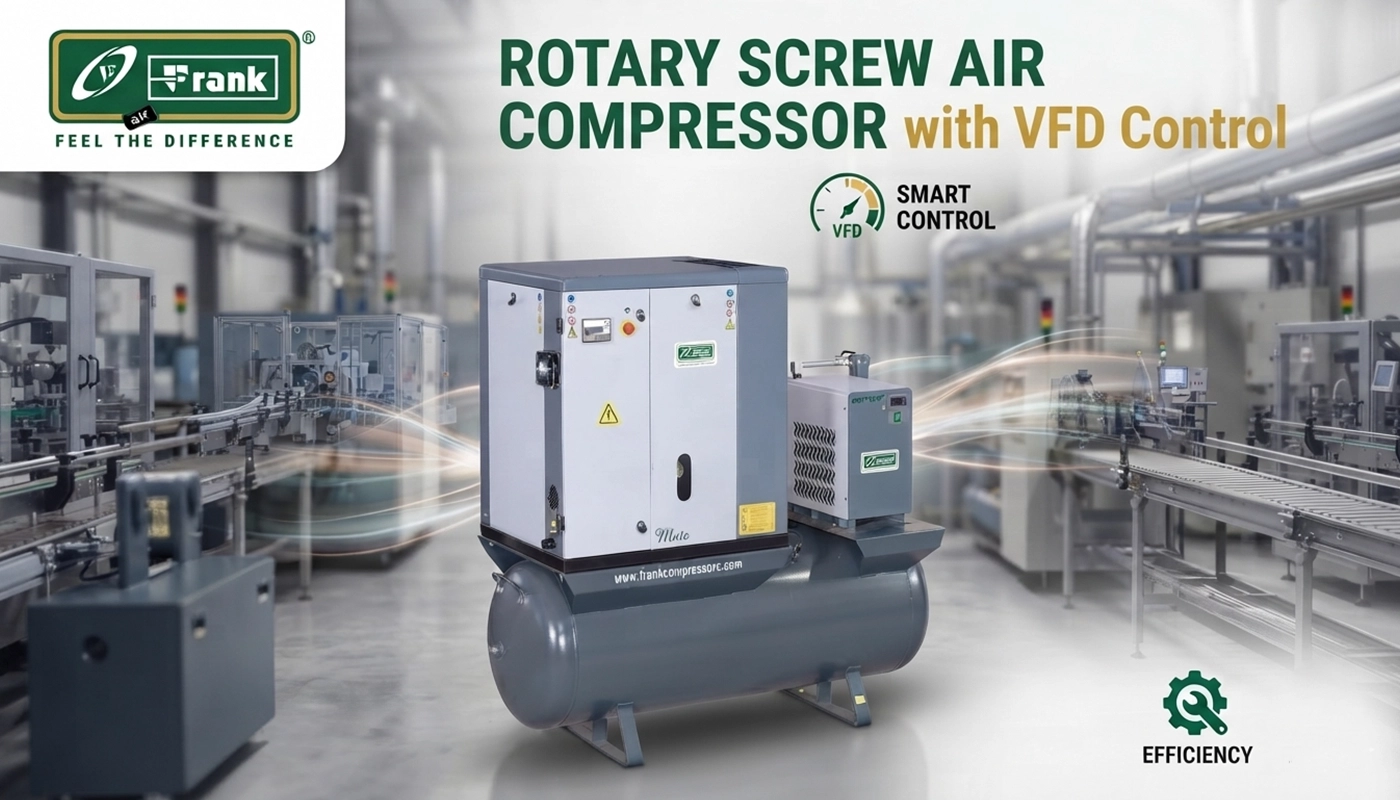
A VFD screw compressor adjusts motor speed according to changing air demand. This makes it particularly suitable for factories where consumption varies between shifts, production stages or operating loads.
| Factory Operating Pattern | Compressor Consideration |
|---|---|
| Stable, consistent demand | Fixed-speed screw compressor |
| Variable demand | VFD screw compressor |
| Multiple shifts with changing loads | VFD or PM motor technology |
| Long operating hours | High-efficiency or direct-drive configuration |
The additional investment in variable-speed technology should be evaluated against operating hours and expected energy savings rather than treated as a standard requirement for every factory.
Permanent Magnet Motor Screw Compressor Efficiency
Permanent magnet motor technology is another consideration for factories with high operating hours and a strong focus on energy consumption.
An IE4 permanent magnet motor can maintain high motor efficiency across operating conditions and, when combined with direct-drive screw technology, can reduce transmission losses associated with conventional belt arrangements. This configuration can be relevant for multi-shift manufacturing plants, textile operations and other facilities where compressors account for a significant portion of electricity consumption.
The potential benefit depends on the actual load profile, operating hours and system design. Motor technology should therefore be assessed together with compressor capacity and demand variation.
Rotary Screw Compressor Drive and Maintenance Features
The compressor's mechanical design also affects operating and maintenance requirements.
Direct-drive systems transfer motor power directly to the compression element, reducing transmission losses and eliminating routine belt replacement associated with belt-driven arrangements. They can be particularly suitable for demanding industrial applications.
Maintenance accessibility is equally important. Routine service commonly involves oil, filters, separators and other wear components. Features such as accessible service panels, adequate cooling capacity and appropriately sized filtration can make scheduled maintenance more practical.
For a factory, compressor selection should consider both how efficiently the machine produces compressed air and how easily it can be maintained.
Rotary Screw Compressor Total Cost of Ownership
The purchase price does not represent the complete cost of owning a compressor. Electricity consumption can become a major operating expense over years of continuous production.
A factory should compare:
- Compressor purchase and installation cost
- Electricity consumption
- Maintenance and replacement parts
- Air dryers and filtration requirements
- Service and technical support
- Expected operating hours
- Future production requirements
A higher-efficiency compressor can have a higher initial cost but may provide stronger lifecycle value when operated for multiple shifts over several years.
Choose Frank Rotary Screw Air Compressors for Your Factory
Selecting the right manufacturer is as important as choosing the correct compressor specification. Frank Compressors combines engineering, machining, assembly, testing and product development to provide compressed-air solutions designed for demanding industrial applications. Frank Compressors offers rotary screw compressors for industrial applications, including oil-injected, oil-free, fixed-speed, VFD and permanent magnet motor configurations. Its engineering, foundry, machining, assembly, testing and R&D capabilities support the development of compressor systems for different factory requirements.
Whether your priority is energy efficiency, continuous operation, variable air demand or specific air-quality requirements, Frank Compressors can help you evaluate the appropriate compressor configuration based on CFM, pressure, duty cycle and operating conditions.
Ready to choose the right compressor for your factory? Explore Frank Compressors' rotary screw compressor solutions and find a configuration suited to your application.

Recent Blogs
- How to Select a Rotary Screw Air Compressor for Factories?
- Why Permanent Magnet Motor Screw Compressor Saves Energy?
- Air Compressors in EV Battery Manufacturing: What to Know?
- How Do VFD Screw Compressors Save 35% on Energy Bills?
- How to Identify and Fix Air Leaks in Compressed Air Systems?
- How to Remove Moisture from Compressed Air Effectively?
- Choosing the Right Air Compressor Capacity for Your Factory
- How Energy-Efficient Compressors Cut Industrial Power Costs
- Single vs Two-Stage Reciprocating Air Compressor Overview
- Top 10 Air Compressor Manufacturers in Coimbatore
- Air Compressors for Electronics & Semiconductor Industry
- Understanding Oil-Free Scroll Air Compressors & Advantages
- Oil-Free vs Oil-Injected Compressors for Textile Industry
- Tips to Pick The Best High-Pressure Compressor For Business
- Key Things to Check Before Installing a PET Air Compressor
- Benefits of Dual-Stage and Single-Stage Air Compressors
- How to Silence an Air Compressor for a Peaceful Workspace?
- Expert Tips to Select Screw Air Compressor For Packaging
- Benefits of Oil-Free Air Compressors For Food & Beverage Safety
- The Importance of Refrigeration Air Dryers in Pharma Production
- Why Choose a Permanent Magnetic Energy Saving Compressor
- The Importance of Air Compressors in Laser Cutting Machines
- How Dental Air Compressors Benefit the Medical Sector
- Key Applications and Benefits of Piston Vacuum Pumps in Industry
- Understanding The Role of Air Dryers in Compressed Air System
- Why Choose Rotary Screw Air Compressors: Essential Advantages
- Innovative Design Features of Screw Compressors with VFD
- Which One to Choose: Piston Vacuum Pumps vs Rotary Vane Vacuum Pumps?
- A Step By Step Guide For Air Compressor Installation & Setup
- Tips For Improve Your Compressor Life Span
- Different Types Of Compressors And Their Uses In Industries
- High-Pressure Air Compressors: Uses and Advantages for Industrial Solutions
- How Air Compressors Are Transforming The Textile Industry ?
- Tips For Prolonging Your Air Compressor's Lifespan