ISO 9001:2015
 ZED Bronze Certified

Reliable Industrial Air Systems for Textile Production
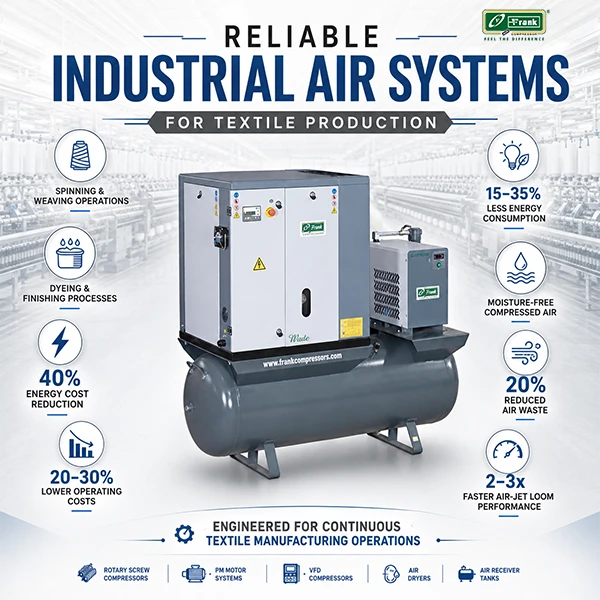
Compressed air supports spinning, weaving, dyeing, conveying, and garment processing operations across textile mills in India. Air-jet looms and pneumatic systems require stable pressure during continuous production, as pressure fluctuation and moisture can affect yarn consistency, loom efficiency, dye quality, and overall production stability. Frank Compressors supplies continuous-duty compressed air systems for textile manufacturing, including rotary screw compressors, PM motor systems, VFD compressors, refrigeration dryers, and air receiver tanks.
- 40% reduction in energy costs with modern rotary screw and VSD compressors.
- 20–30% drop in overall operational energy spend in facilities running well-managed compressed air systems.
- 15–35% lower energy consumption with high-efficiency compressors depending on system design and air demand.
- 20% less energy waste through demand-side airflow management, plus 7% saved for every 1-bar pressure reduction.
- 2–3x faster production speeds on air-jet looms compared to traditional shuttle methods.


Compressed Air Solutions for Textile & Spinning Plants
Compressed air is used in textile mills during the spinning, weaving, dyeing, conveying and garment processing operations. Air-jet is present and there is a need for constant pressure in pneumatic systems during continuous production shifts.
In textile production lines, pressure fluctuation influences the timing of weft insertion, consistency and efficiency in the looms. Small amounts of instability can cause poor performance of the process at high manufacturing speeds.
Moisture inside compressed air systems can cause fabric spotting, uneven dye absorption, valve corrosion, and higher yarn breakage rates. Frank Compressors supplies compressed air systems designed for textile manufacturing operations.
Years Experience
Happy Clients
Countries Served
Rotary Screw Air Compressors (Mute / Mute HD Series)
The Mute and Mute HD series deliver stable low-pulsation airflow for spinning frames, weaving sheds, and pneumatic conveying systems operating continuously across textile plants. Oil carryover stays below 3 PPM, while high-efficiency intake filters handle lint-heavy spinning environments without affecting airflow stability.

| Technical Feature | Specification Details |
|---|---|
| Power Range | 3 HP to 125 HP / 2.2 kW to 90 kW |
| Working Pressure | 7 to 13 kg/cm² |
| Airflow Capacity | 9.5 CFM to 572 CFM |
| Noise Level | 61 dB(A) to 74 dB(A) |
| Primary Applications | Air-jet looms, spinning frames, pneumatic conveying systems |
Permanent Magnet Motor Screw Compressors (Cute Series)
The Cute series features an IE4 permanent magnet motor, which saves up to 50% energy over fixed-speed compressors, along with a rotary screw air end. Its direct drive system eliminates belt losses and provides steady airflow during continuous, multi-shift textile production.
| Technical Features | Specification Details |
|---|---|
| Power Range | 10 HP to 125 HP / 7.5 kW to 90 kW |
| Working Pressure | 7 to 8 kg/cm² |
| Airflow Capacity | 45 CFM to 642 CFM |
| Motor Efficiency | IE4-grade permanent magnet motor |
| Load Control Range | 20% to 110% |
| Primary Applications | High-volume spinning mills, multi-shift weaving plants |

VFD Screw Compressors
Textile plants rarely operate at one fixed air demand throughout the day, especially during maintenance or lower night-shift production. Frank Compressors VFD systems automatically adjust motor speed according to live airflow demand, reducing idle power consumption and maintaining stable pressure.

| Technical Feature | Specification Details |
|---|---|
| Power Range | 10 HP to 125 HP / 7.5 kW to 90 kW |
| Working Pressure | 7 to 13 kg/cm² |
| Airflow Capacity | 35 CFM to 572 CFM |
| Operating Band | 2 PSI operating range |
| Primary Applications | Variable-shift weaving plants, spinning mills, textile processing units |
Reciprocating Air Compressors (Giant Series)
The Giant series uses cast iron multi-cylinder blocks with oversized cooling fins designed for repeated stop-start operation across garment and knitting units. These systems support cutting tables, sewing pneumatics, pressing equipment, and smaller textile sections with intermittent airflow demand.
| Technical Features | Specification Details |
|---|---|
| Power Range | 1 HP to 25 HP / 0.75 kW to 18.5 kW |
| Working Pressure | 7 to 12.5 kg/cm² |
| Airflow Capacity | 3 CFM to 75 CFM |
| Build | Cast iron multi-cylinder construction with radial cooling fins |
| Primary Applications | Garment units, knitting workshops, textile processing sections |

Refrigeration Air Dryers
Wet compressed air impacts on lines of textile production; such as weft insertion accuracy, fabric quality, dye consistency, pneumatic valve reliability. Frank Compressors refrigeration dryers remove moisture from the air prior to it entering the distribution system, providing more uniform air moisture levels throughout textile processing.

| Technical Features | Specification Details |
|---|---|
| Function | Moisture removal from compressed air systems |
| Primary Applications | Air-jet looms, dyeing lines, spinning frames, pneumatic controls |
| Key Protection | Prevents fibre damage, moisture spotting, and valve corrosion |
| Compatibility | Compatible with all Frank Compressors systems |
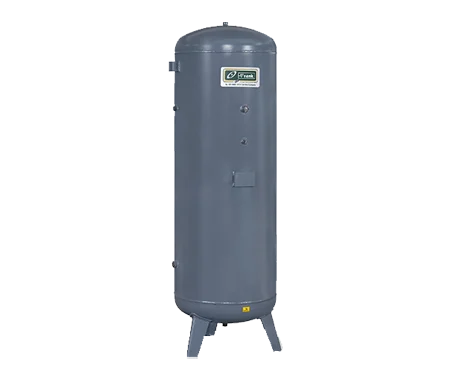
Air Receiver Tanks (ARV Series)
Multiple looms and spinning frames pulling compressed air together create sudden pressure drops across textile plants during shift startup. Frank Compressors ARV tanks store reserve compressed air, stabilize pressure, and reduce compressor cycling across the distribution network.
| Technical Features | Specification Details |
|---|---|
| Storage Capacity | 500 Litres to 10,000 Litres |
| Working Pressure | 7 to 45 kg/cm² |
| Compliance | ISO 9001:2015 certified pressure vessels |
| Primary Applications | Spinning mills, weaving sheds, textile production buffering |
How Compressed Air is Used Across Textile Production
Air-Jet Weaving
The weft yarn is fed at high speed through the warp shed via high velocity air nozzles. Accurate pressure stability at all points of the loom is required for this continuous micro-propulsion, to avoid misaligning the fabric or stopping the machine.
Ring, Open-End, and Air-Jet Spinning
Automated spinning frames utilize precise pneumatic airflow to manage fiber twisting, maintain uniform yarn tension control, and handle automatic suction tasks that prevent overlapping strands.
Texturizing & Bulking
High-pressure air jets mechanically interlace, bulk, and loop synthetic filaments during processing. This turbulent air environment is critical for maintaining a uniform, premium texture across finished yarn packages.

Pneumatic Material Conveying
Pressurized air streams safely transfer loose raw cotton, dense wool fibers, yarn bobbins, and raw plastic PET chips between different processing departments, eliminating manual handling and reducing material transit damage.

Garment Assembly & Processing
Pneumatic cylinders drive high-speed automated cutting tables, specialized sewing machine attachments, pocket setters, and fabric pressing equipment inside modern garment fabrication factories.

Warping & Sizing Operations
Pneumatic braking and tensioning networks maintain perfectly even thread winding onto the section beams during warping and sizing phases, stabilizing the yarn structure before weaving begins.
Automated Cone & Bobbin Winding
High-speed autoconers use compressed air to actuate automatic yarn splicing mechanisms, handle empty bobbin changes, and power the suction tubes that clear out yarn ends during high-speed winding.

Moisture & Chemical Dyeing Extractions
Following chemical immersion or coloration cycles, controlled high-pressure air streams pass through fabric lines to force out excess liquid and chemicals, significantly lowering the total thermal energy required during subsequent heat drying phases.

Screen & Rotary Fabric Printing
In today's printing lines, doctor blades, squeegees and lifting frames are moved with exactness and rhythm by compressed air, to create a crisp and even dye layout spread over the width of the fabric.
Automated Optical Fiber & Color Sorting
Natural fiber is fed into high-speed blow-room equipment at the start of spinning, where optical sensors detect contaminants. In milliseconds, without interrupting the process, ultra-fast and precise bursts of compressed air blast discolored patches, seeds, or foreign matter.

Hosiery & Circular Knitting Automation
Circular knitting machines, which are driven by small pneumatics cylinders, select the needles, control the tension when elastic yarn is fed around the cylinder, and employ down-draft air suction when the finished sock or knit tube is being pulled into the collecting bin.
Non-Woven Fabric Production (Meltblown and Spunbond)
In the modern technical textile production, molten polymer is extruded through small nozzles and cooled with high temperature and high velocity compressed air to break the polymer into ultra-fine fiber web for medical mask and filter media.

Flocking & Surface Texturing
Compressed air spray networks propel short fiber fragments onto pre-glued backing fabrics, fixing them vertically to create uniform velvet-like pile finishes.
Denim Sandblasting
Pneumatic blasting cabinets propel abrasive media onto denim garments to achieve consistent fading and distressing effects rapidly across production batches.
Plant Waste, Dust, and Lint Extraction
Continuous-duty air loops operate central vacuum networks and traveling cleaners that slide above spinning and weaving frames. These systems blast away falling lint and collect fiber debris to prevent fire hazards and machinery clogging.

Fabric Stentering & Tenter Frame Adjustment
Industrial stenter machines use pneumatic controllers to automatically adjust width-stretching tracks, operate edge-guiding sensors, and regulate heavy padder rollers to ensure uniform fabric width and moisture alignment.
Wastewater Treatment Aeration
Large textile dyeing plants generate high volumes of chemical wastewater. Continuous-duty air systems supply oxygen to aeration tanks for biological dye treatment before water discharge.

Why Spinning Mills Across India Choose Frank Compressors

Textile Environment Engineering
Systems designed for airborne fiber conditions and continuous textile production operations.

Certified Performance Validation
Every machine undergoes full-load testing under ISO 9001 quality systems before dispatch.

Localized National Upkeep
Technical support and genuine spare parts are available across major textile manufacturing regions.
Choosing the Right Air Compressor for Textile Mills
Correct compressor sizing helps avoid pressure drops and unnecessary electricity waste across textile production lines.
Map all compressed air draw points
List machines operating together during peak textile production and calculate total CFM demand.
Size for simultaneous shift startup
Textile mills often start multiple machines together, creating peak compressed air demand.
Add a 25 to 30% capacity buffer
Extra capacity supports future expansion, pipeline leakage, and long-shift operation stability.
Confirm your pressure baseline
Air-jet looms commonly require 5 to 7 kg/cm² pressure during textile production.
Get the Right Compressed Air System for Textile Mills
Spinning mills, weaving units, dyeing plants, and garment factories operate with different airflow, pressure, and air quality requirements. Frank Compressors configures systems around actual machine load, shift operation, and plant layout for stable textile production performance.